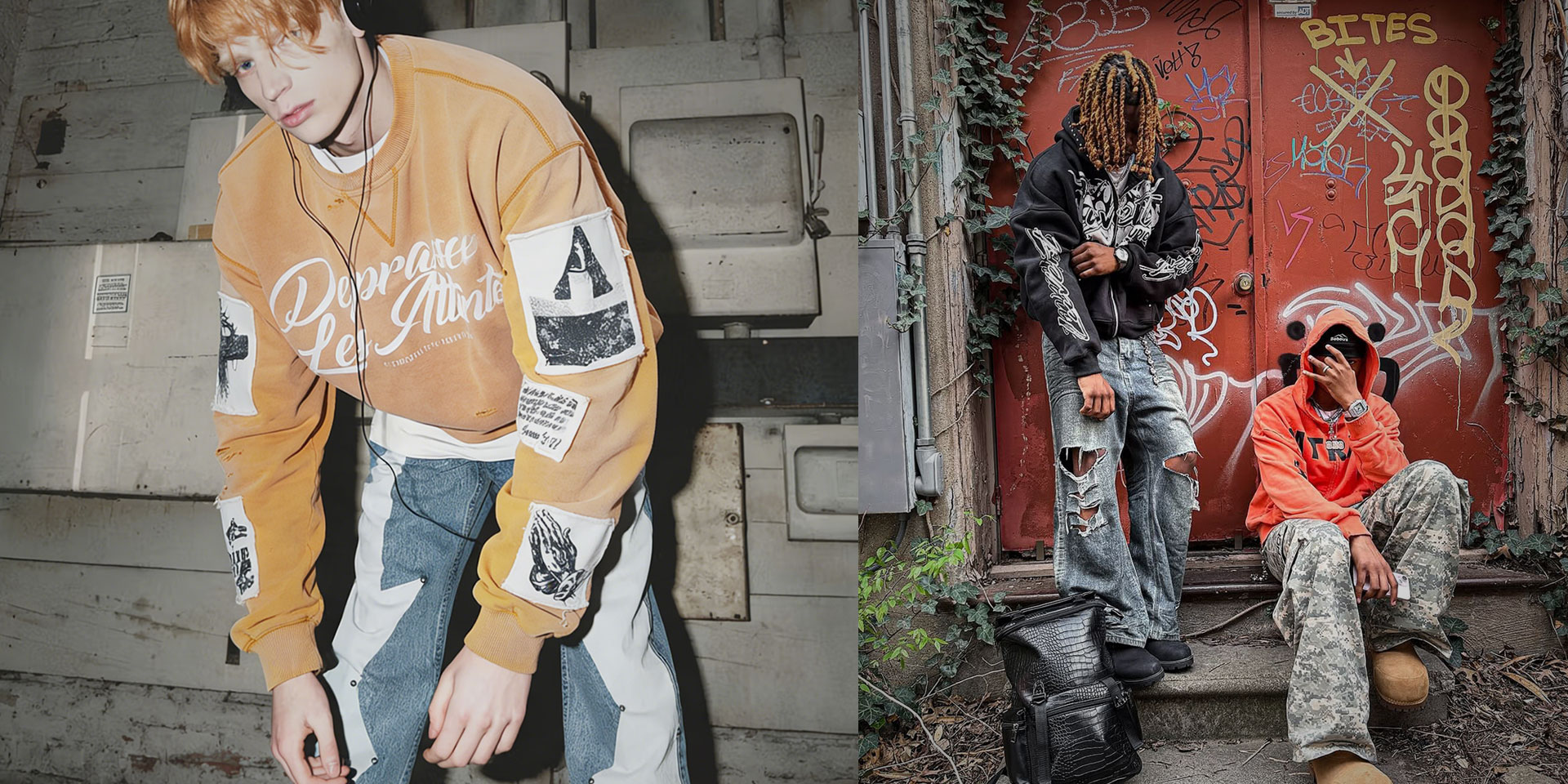
Can Luxury Retro Clothing Be Produced at OEM Scale Without Losing the Approved Sample Standard?
A perfectly executed vintage wash on a single sample is an art form. But replicating that exact same fade, hand-feel, and drape across 5,000 units without a single batch variation? That is a brutal supply chain reality. For established streetwear brands and fashion labels with real retail traction, the transition from sample approval to bulk production is where the most critical failures happen.
Luxury retro clothing—defined by its heavyweight fabrics, complex distressing, enzyme washes, and precise oversized silhouettes—demands a level of technical execution that standard apparel factories simply cannot handle. When independent brands with proven sales attempt to scale their retro collections, they often discover that their approved sample was a masterpiece, but their bulk delivery is a disaster. The shrinkage rates are inconsistent, the acid wash looks cheap, the cracked print peels off entirely, and the boxy fit suddenly feels like a generic oversized blank.
This article breaks down the exact technical barriers of scaling luxury retro clothing. We will explore why sample-to-bulk mismatch occurs, how specific wash and fabric choices amplify production risks, and what procurement teams must verify before committing to an OEM streetwear manufacturer.
Why Is Scaling Luxury Retro Clothing More Technical Than Basic Apparel Production?
Scaling luxury retro clothing requires precise control over fabric shrinkage, wash intensity, and pattern engineering across large volumes. Unlike basic apparel, retro streetwear relies on destructive techniques like acid washing and distressing, which introduce high batch-level variation if the manufacturer lacks specialized execution protocols.
The fundamental difference between standard clothing and luxury retro streetwear lies in the predictability of the materials and the intensity of the manufacturing environment. A basic cotton t-shirt is a linear product: it is cut, sewn, and shipped with minimal intervention. A luxury retro hoodie, however, is subjected to extreme chemical and physical stress before it ever reaches the finishing stage. The garment must survive aggressive industrial processes while maintaining its structural integrity and intended silhouette.
When a specialized streetwear factory develops a vintage wash, they are intentionally breaking down the fabric fibers to achieve a specific aesthetic. This is not a superficial treatment; it is a fundamental alteration of the material's DNA. This process alters the weight, the drape, and the dimensions of the garment. If the pattern development phase does not account for the exact shrinkage rate of that specific wash on that specific fabric roll, the final bulk production will not match the approved sample. The complexity deepens when considering that different dye colors react differently to the same wash formula. A black pigment-dyed hoodie might shrink 4% during an enzyme wash, while a vintage red version of the exact same fabric might shrink 6%. Without rigorous testing and separate pattern adjustments for each colorway, the size run will be completely unbalanced.
For product development teams, the risk is not just aesthetic; it is structural. A 400gsm French Terry hoodie might feel perfect in the sample stage, but if the bulk fabric sourcing is inconsistent, the enzyme wash will react differently across different rolls. This leads to a nightmare scenario where half the production run fits perfectly, and the other half is two inches shorter in the body length.
What Should Procurement Teams Check Before Approving a Heavyweight Retro Sample?
Procurement teams must verify the pre-wash and post-wash fabric weight, the exact shrinkage tolerance, and the consistency of the dye lot. Approving a heavyweight retro sample without testing its performance across multiple wash cycles guarantees severe sample-to-bulk misalignment during full-scale production.
Heavyweight cotton is the foundation of luxury retro clothing. Whether it is a 300gsm vintage t-shirt or a 500gsm distressed hoodie, the fabric weight dictates the silhouette. However, weight alone does not guarantee quality. The hand-feel—how the fabric drapes and moves—is equally critical.
When evaluating an OEM streetwear manufacturer, sourcing teams must look beyond the initial sample. A common failure point is the substitution of premium combed cotton with cheaper carded cotton during bulk production. The sample feels luxurious, but the bulk feels stiff and abrasive after the first wash.
To prevent this catastrophic misalignment, procurement teams must demand a pre-production sample (PPS) that uses the exact bulk fabric roll, not just a similar yardage sourced from a local market. The hand-feel must be evaluated after the fabric has undergone the full wash process, as the chemical treatments will strip away the initial softness of the raw cotton. Furthermore, the tech pack review must explicitly state the acceptable tolerance for shrinkage and weight variance. In luxury retro clothing, a 3% shrinkage tolerance might be acceptable on a standard length garment, but a 5% shrinkage on a cropped, boxy fit will completely ruin the intended silhouette, exposing the wearer's waistline and destroying the architectural drape of the piece. Sourcing teams must also verify the GSM (grams per square meter) post-wash, ensuring the fabric retains its heavy, premium feel even after the destructive finishing processes.
How Do Wash Techniques Change Bulk Production Risk?
Wash techniques like acid wash, stone wash, and enzyme wash introduce extreme chemical variables that can destroy fabric integrity or cause severe color inconsistency. Bulk production risk increases exponentially because these washes react differently to minor fluctuations in water temperature, chemical concentration, and machine load size.
The aesthetic of luxury retro clothing is heavily dependent on the wash. An acid wash t-shirt or a stone-washed denim jacket carries a specific cultural weight that cannot be faked. However, these techniques are inherently unstable.
Consider the stone wash process. Pumice stones are loaded into industrial washing machines alongside the garments to physically abrade the fabric. In a sample run of five pieces, the manufacturer can carefully monitor the abrasion level. But in a bulk run of 2,000 pieces, the ratio of stones to garments, the exact duration of the cycle, and the degradation of the stones themselves all impact the final result.
If a streetwear clothing manufacturer lacks strict batch-level control, the result is a production run where some garments look perfectly vintage, while others look heavily damaged or barely washed at all. For brands with established sales channels, this level of inconsistency is unacceptable. It leads to high return rates and damages the brand's premium positioning.
To mitigate this risk, product teams must require wash testing across different fabric lots before bulk cutting begins. The manufacturer must prove they can replicate the exact wash formula—water temperature, chemical ratio, and cycle time—consistently across multiple industrial machines. Furthermore, the capacity of the wash machines must be strictly regulated. Overloading a machine to save time will result in uneven abrasion, where garments in the center of the load receive less stone contact than those on the outside. A premium streetwear manufacturer will establish a strict load limit for every wash cycle, prioritizing batch-level consistency over sheer output speed. This meticulous control is what separates a high-quality vintage finish from a cheap, mass-produced imitation.
Why Does an Oversized Fit Require Real Pattern Development Instead of Simple Size Enlargement?
An oversized fit requires precise pattern engineering to drop the shoulders, widen the chest, and adjust the armholes without making the garment look sloppy. Simply grading up a standard size block ruins the silhouette, causing the neckline to gape and the hem to bunch awkwardly.
One of the most misunderstood aspects of luxury retro clothing is the silhouette. The oversized, boxy, or baggy fits that define modern streetwear are not achieved by simply ordering an XXL instead of a Large. They require intentional pattern development.
When a brand transitions from a standard fit to a retro oversized fit, the entire geometry of the garment changes. The shoulder seam must drop to a specific point on the bicep, but the sleeve length must be adjusted accordingly so it doesn't swallow the wearer's hands. The chest must be widened to create a boxy drape, but the hem must be engineered to sit cleanly without flaring out.
Many general apparel factories fail at this because they rely on standard grading rules. They take a basic block and scale it up uniformly. This results in a garment that looks like a mistake rather than a deliberate design choice.
A specialized streetwear factory understands that pattern development for oversized fits is a distinct discipline requiring advanced spatial awareness. They adjust the armhole depth to accommodate the dropped shoulder, ensuring the sleeve does not restrict movement. They engineer the neckline to remain tight and structured, often utilizing a thicker, higher-density ribbing to prevent the collar from stretching out under the weight of the heavy cotton body. Additionally, the grading rules must be customized; the width of the garment might increase significantly between sizes, while the length remains relatively static to preserve the boxy proportion. For independent brands with real traction, partnering with a manufacturer that understands this architectural difference is non-negotiable. The pattern must dictate the fit, not the limitations of a generic factory's standard templates.
What Makes Print and Distressing Placement Difficult in Streetwear Production?
Print and distressing placement is difficult because the garment's dimensions change dramatically after washing and shrinking. If graphics or distressed details are applied before the final wash, their positioning will shift unpredictably, ruining the intended visual balance of the retro design.
Luxury retro clothing often features cracked prints, puff prints, or heavy distressing along the hems and seams. The challenge is not just executing these techniques, but placing them accurately.
In standard production, a screen print is applied to the cut panels before sewing. But in retro streetwear, the garment often undergoes an aggressive enzyme or acid wash after it is sewn. If a graphic is printed before the wash, the fabric shrinkage will pull the print out of alignment. A chest logo that was perfectly centered on the sample might end up sitting two inches higher on the bulk production.
Similarly, distressing must be calculated with the final shrinkage in mind. A destroyed hem on a hoodie might look perfectly rugged on the sample, but if the bulk fabric shrinks more than expected, the distressing will sit too high on the waist, altering the entire proportion of the piece.
To solve this, a premium streetwear manufacturer will conduct extensive print and wash testing. They will determine the exact shrinkage rate of the fabric, adjust the pattern to compensate, and only then finalize the placement of the graphics and distressing. In many cases, the most complex graphics must be applied after the garment has been fully washed and dried, requiring specialized printing equipment capable of handling fully constructed, bulky garments rather than flat fabric panels. This level of sample-to-bulk alignment requires a slower, more deliberate production timeline, but it is what separates high-quality custom streetwear production from cheap imitations. The visual impact of a retro garment relies entirely on the precise execution of these finishing details.
How Should Brands Compare a General Apparel Factory With a Specialized Streetwear Manufacturer?
Brands should evaluate a manufacturer based on their ability to handle heavy fabrics, complex washes, and custom silhouettes, rather than just their production capacity. A specializedstreetwear manufacturerpossesses the specific machinery and technical expertise required to execute destructive washes and oversized patterns without compromising quality.
When established streetwear brands look to scale their production, they often make the mistake of choosing a factory based solely on capacity and price. They assume that a factory that produces millions of basic t-shirts can easily handle a run of 500gsm vintage-washed hoodies. This is a critical error.
A general apparel factory is optimized for speed and uniformity. Their assembly lines are set up for lightweight, predictable fabrics. When introduced to heavyweight cotton or complex wash requirements, their efficiency drops, and their defect rate skyrockets. Their sewing machines may struggle to punch through multiple layers of 400gsm fleece, leading to skipped stitches and broken needles.
In contrast, anOEM streetwear manufactureris built for complexity. They have the heavy-duty sewing equipment necessary for thick fabrics. They have established relationships with specialized wash houses that understand the nuances of pigment dyeing and stone washing. Most importantly, they have a quality control process that is calibrated for the specific risks of streetwear production.
For brands evaluating new concepts before expansion, the choice of manufacturing partner dictates the final product quality. A specialized partner provides the strategic flexibility for validated concepts, ensuring that the transition from sample to bulk does not dilute the brand's premium positioning.
Which Quality Checks Matter Before Bulk Streetwear Production?
Before bulk production, procurement teams must enforce strict quality checks on fabric shrinkage, wash consistency, print durability, and sewing tolerance. Approving the pre-production sample (PPS) is the final safeguard against catastrophic batch-level variations in the final delivery.
The final inspection of the bulk delivery is too late to catch systemic production errors. In luxury retro clothing, quality control must happen before the bulk cutting begins.
The most critical checkpoint is the pre-production sample (PPS). The PPS must be created using the exact bulk fabric, the exact bulk trims, and the exact bulk wash process. If the manufacturer substitutes any element "just for the sample," the PPS is invalid.
During the tech pack review and PPS approval, product teams must verify the sewing tolerance. In standard apparel, a 1-inch tolerance might be acceptable. But in a cropped, boxy t-shirt, a 1-inch variance in the body length completely changes the fit.
Furthermore, print and embroidery testing must be conducted on the washed fabric. A cracked print must be tested for durability to ensure it flakes aesthetically rather than peeling off entirely. An appliqué or embroidery patch must be checked for puckering, ensuring that the heavy stitching does not distort the surrounding fabric.
By enforcing these rigorous pre-bulk quality checks, streetwear brands with proven market demand can scale their production confidently. The goal is not just to produce clothing, but to execute a vision with absolute precision, ensuring that the 5,000th unit carries the exact same cultural weight and technical perfection as the very first approved sample.
Scaling luxury retro clothing is a brutal test of supply chain capability. It requires a manufacturing partner that understands the delicate balance between destructive aesthetic techniques and rigorous quality control. For independent brands with real traction, the transition from sample to bulk is the ultimate proving ground. By groovecolor prioritizing specialized technical execution over generic production capacity, brands can ensure their retro collections maintain the premium standard their audience expects. As a reference point for specialized custom streetwear production,Groovecolorrepresents the type of China-based technical production capable of managing these complex sample-to-bulk transitions, ensuring that the integrity of the original design is never lost at scale.